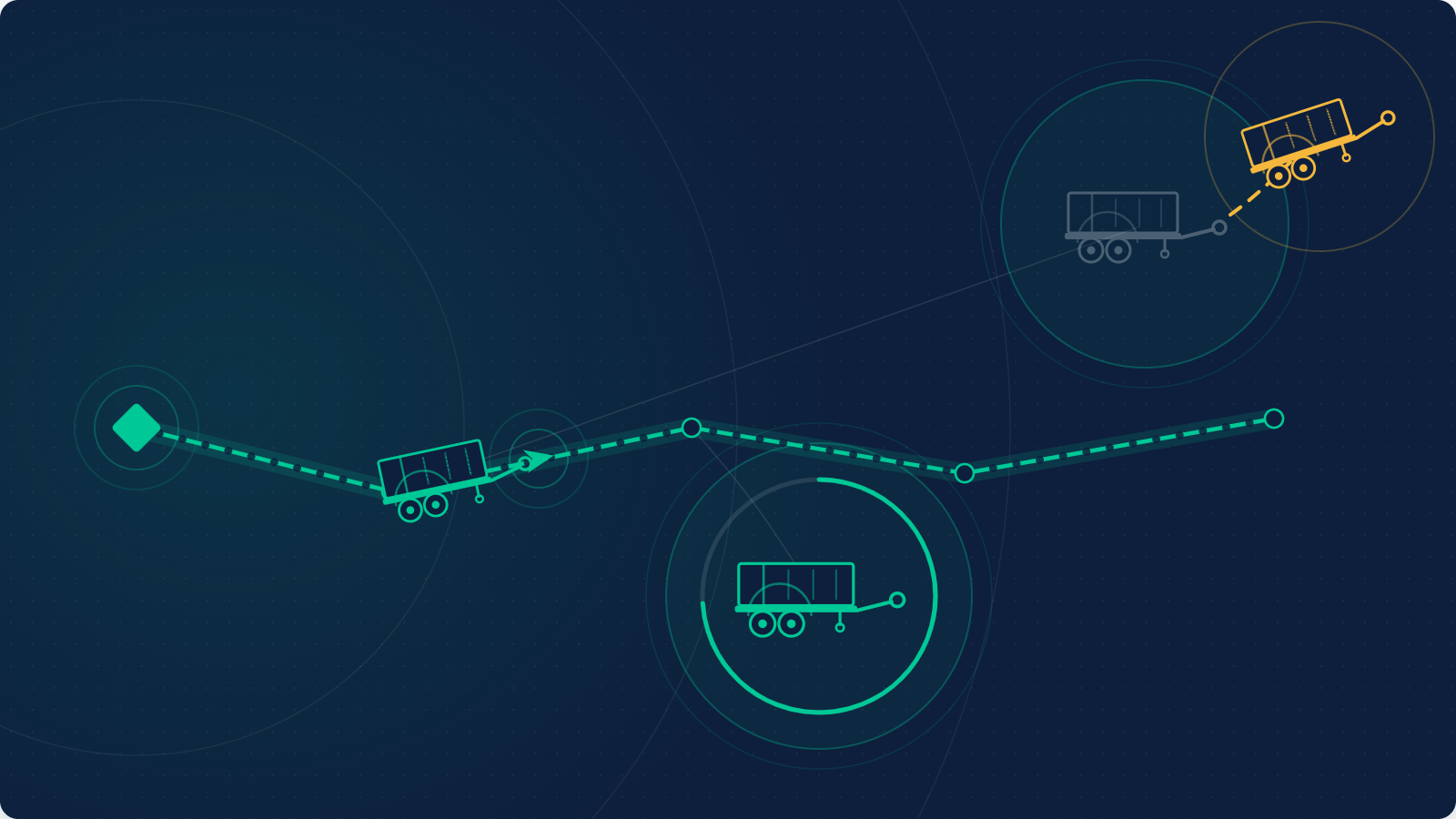
Unhitched means invisible.
A trailer without its own tracking is only as visible as the vehicle that last towed it. The moment it’s unhitched, it disappears from view. That’s how a trailer ends up sat on a customer’s site for a fortnight after the job’s done, or goes missing off a yard overnight without anyone noticing until someone needs it. That’s downtime waiting on a trailer that should already be free, and a real theft risk with no way to know where it’s gone.
How TotalCtrl’s trailer tracking works.
Everything trailer tracking covers.
- ✓Live GPS location for every trailer, independent of the towing vehicle
- ✓Movement and towing detection, so an unexpected move triggers an alert rather than going unnoticed
- ✓Geofencing for trailers left on site for extended periods, with alerts on unauthorised movement
- ✓Dwell time reporting: how long a trailer's been sat at a location, and whether it's overdue to move
- ✓Full location history, so "where's trailer 12" has a real answer without a phone call round the depots
Built for how different field teams actually work.
Same trailer platform, tuned to the way each sector deploys them.
Renewable & Solar
Plant and welfare unit trailers move between remote sites over long distances, where losing track of one means a real delay getting it back.
Commercial HVAC/M&E
Generator and equipment trailers deployed for standby power or planned works need to be accounted for the moment the job wraps up.
Specialist Field Engineering
Trailers carrying specialist rigs or test equipment are high-value and low-volume, so knowing exactly where one is matters more than for a common trailer.
Grounds Maintenance
Plant trailers move between sites daily during peak season, and a missing one holds up the next crew waiting on it.
The operational shifts customers see.
- →Trailers found in minutes instead of a round of phone calls to depots and sites
- →Fewer trailers sat idle on finished jobs, freeing them up for the next one sooner
- →A real deterrent and a location trail if a trailer is taken
- →Clear dwell-time data to challenge sites that hold onto a trailer longer than agreed
Questions we get asked.
What is trailer tracking?
It's independent GPS tracking fitted to the trailer itself, so its location, movement and dwell time are known regardless of which vehicle towed it there or whether it's currently attached to anything.
Why can't vehicle telematics cover this?
Vehicle telematics only sees the trailer while it's hitched to a tracked vehicle. The moment it's dropped at a site or left on a yard, it has no engine or telematics unit of its own to report from. A dedicated trailer tracker closes that gap.
Can it tell the difference between expected and unexpected movement?
Yes. A trailer parked in a geofenced zone that starts moving outside expected hours or outside that zone triggers an alert rather than being treated as routine.
Does this help if a trailer is stolen?
Yes. Continuous GPS location means a stolen trailer can be tracked in real time rather than relying on a last-known position from whenever it was last hitched to a vehicle.
How is this different from asset tracking?
Asset tracking covers equipment and plant that gets deployed to a site. Trailer tracking is built specifically around towing and dwell-time behaviour, detecting when a trailer starts or stops moving, and how long it's been sat somewhere.
Explore next
Asset Tracking
GPS tracking for high-value plant and equipment.
Explore →
Container Tracking
Geofenced containers with tamper and door-open alerts.
Explore →
Tool Tracking
BLE-tagged tools tracked at a fraction of GPS cost.
Explore →
Grounds Maintenance
Plant trailers move between sites daily during peak season.
Explore →