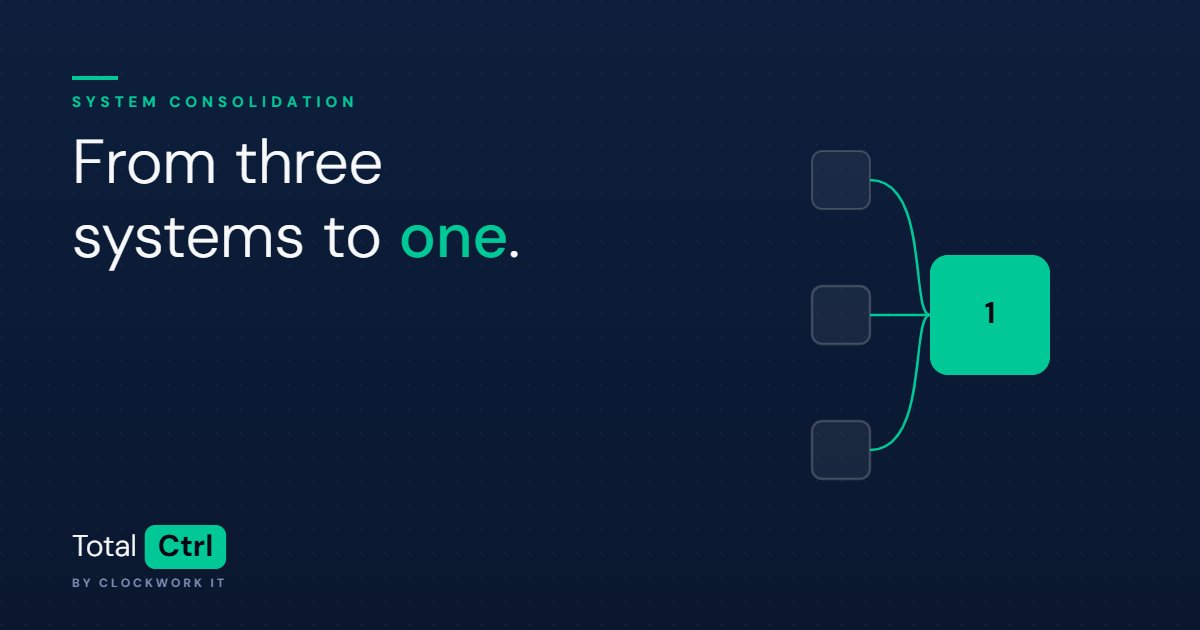
What is field service system consolidation?
Consolidation means replacing several specialised tools (separate systems for scheduling, mobile job management, stock and reporting) with one platform that does all of it on shared data. Instead of moving information between systems, every team works from a single source of truth.
It is the most common turning point for a growing field service business. The stack that got you to forty engineers (a scheduling tool here, a mobile app there, a finance package bolted on) quietly becomes the thing holding you back.
The hidden cost of running disconnected systems
When systems do not talk to each other, the cost is rarely on an invoice. It is spread across every working day:
Data is delayed, duplicated or dropped. Information passed by hand between platforms arrives late or not at all, so job records, stock levels and engineer status drift out of step.
Double entry everywhere. The same job is keyed into scheduling, then again into finance, then reconciled at month end. That is paid-for time spent moving data, not serving customers.
Errors are hard to trace. When something is wrong, no one system holds the full picture, so finding the cause means cross-checking three.
Licences and training stack up. Every system carries its own subscription, its own login and its own learning curve for new starters.
Signs your field service stack has outgrown itself
Planners keep a spreadsheet "on the side" because no single system shows them everything.
A customer query needs two or three tools open to answer.
Month-end reconciliation is a recurring fire drill rather than a routine.
Nobody fully trusts the stock figures.
How to consolidate without breaking operations
1. Map the workflows, not the features
Start from how a job actually flows (booked, scheduled, completed, invoiced) rather than a feature checklist. The goal is one unbroken path, not the union of every box your current tools tick.
2. Prioritise the integrations that matter
Consolidation rarely means everything in one box. It means one operational platform that integrates cleanly with the systems you keep, finance being the obvious one. A platform that connects to the finance package you already run, whether that is Sage, Xero, QuickBooks or another, removes the biggest reconciliation headache on day one.
3. Migrate in phases, with hypercare
Move in deliberate stages rather than a single switch-over, and run a hypercare period of close, hands-on support through the first weeks live, when edge cases surface and confidence is built.
4. Decommission deliberately
Consolidation only pays back when the old systems are switched off. Set a date to retire each one, otherwise you carry the cost of the new platform on top of the old, and capture none of the saving.
From three systems to one is not a software project. It is removing the seams where your data, and your margin, leak away.
The ROI case: from three systems to one
The return comes from three places at once: admin time recovered when double entry disappears, margin protected when stock and job data finally agree, and subscription and training costs removed as legacy tools are retired. For most mid-market operators, the recovered planner hours alone justify the move, before a single licence is cancelled.
Frequently asked questions
What does it mean to consolidate field service software?
It means replacing multiple disconnected tools (scheduling, mobile, stock, reporting) with a single platform built on shared data, so teams stop re-keying information between systems and work from one source of truth.
Will consolidating disrupt our operations?
It need not. A phased migration with a defined hypercare period lets you move workflow by workflow, keep operations running throughout, and decommission legacy systems only once their replacement is proven.
Can a single platform integrate with our finance system?
Yes. Consolidation does not require finance to live in the same tool. It requires a clean, reliable integration. A platform that connects to common finance packages such as Sage, Xero and QuickBooks removes manual reconciliation while leaving your finance system in place.